Cloud 3.0 explained — AI-native infrastructure, edge computing, and enterprise cloud architecture in 2026

Cloud 3.0 Explained: The Future of AI-Native Infrastructure in 2026

Cloud computing is entering its third generation — one built around artificial intelligence, distributed edge processing, and zero-trust governance. Here is what it means, why it matters, and how enterprises should respond.

Last updated June 2026  ·  18 min read

⚡ Featured Answer — What Is Cloud 3.0? Cloud 3.0 is the third generation of cloud computing — a shift from application-hosting platforms to intelligence-driven, distributed ecosystems. It treats AI workloads as first-class infrastructure primitives, extends compute to the network edge, enforces zero-trust security at every layer, and prioritises energy efficiency as an architectural requirement, not an afterthought.

The first wave of cloud computing gave us virtualised infrastructure — the ability to rent servers and storage instead of building data centres. The second wave gave us platforms and software as a service — databases, serverless functions, and entire business applications delivered over the internet.

The third wave is different in kind, not just degree. Cloud 3.0 is not simply "more cloud." It is a fundamental rethinking of where computing happens, how it is governed, what hardware it runs on, and what role artificial intelligence plays — not as a workload running on the cloud, but as an intelligence layer woven into the infrastructure itself.

For enterprise architects, CIOs, and infrastructure engineers, understanding Cloud 3.0 is no longer optional. The decisions made in 2026 about platform strategy, AI readiness, and edge architecture will determine competitive positioning for the rest of the decade.

$2.4T Global cloud market projected by 2030 (Gartner)
75% Enterprise data generated outside the data centre by 2025 (IDC)
40× Growth in AI inference demand 2023–2026 (NVIDIA)
3% Global electricity consumed by data centres in 2026 (IEA)

📋 In This Guide

  1. Key Takeaways
  2. Cloud 1.0 vs 2.0 vs 3.0 — The Three Generations
  3. The Four Core Pillars of Cloud 3.0
  4. Pillar 1: AI-Native Infrastructure
  5. Pillar 2: Distributed Edge & Micro-Clouds
  6. Pillar 3: Confidential Computing & Zero-Trust Governance
  7. Pillar 4: Sustainable & Energy-Efficient Operations
  8. How to Build a Cloud 3.0 Strategy
  9. Top Cloud 3.0 Trends for 2026
  10. Frequently Asked Questions
  11. Conclusion & Future Outlook

Key Takeaways — Cloud 3.0 in 2026

Cloud 1.0 vs Cloud 2.0 vs Cloud 3.0 — The Three Generations

Cloud computing has evolved through three distinct architectural generations, each representing a fundamental shift in what the cloud is for, not just how it works.

Dimension Cloud 1.0 2006–2015 Cloud 2.0 2015–2023 Cloud 3.0 2024–Present
Core Paradigm Infrastructure virtualisation — rent servers instead of buying them Platform & SaaS — managed services and software delivery AI-native, distributed intelligence — compute follows data, AI is infrastructure
Primary Workloads Web apps, VMs, basic storage Microservices, serverless, containerised apps, SaaS AI/ML inference, real-time analytics, edge IoT, generative AI
Key Technology VMs, hypervisors, block storage (EC2, S3) Kubernetes, Lambda, managed DBs, CI/CD pipelines GPU clusters, NPUs, CXL memory fabrics, confidential TEEs, AIOps
Compute Location Centralised data centre Multi-region data centres, some CDN edge Hybrid: central cloud + regional micro-clouds + device edge
Security Model Perimeter firewall — "castle and moat" IAM, VPCs, shared responsibility model Zero-trust, confidential computing, workload attestation, CSPM
Networking 10GbE, basic VPN 100GbE, SD-WAN, service mesh 400G–800G Ethernet, InfiniBand, RDMA, CXL interconnects
Management Manual provisioning, basic monitoring Infrastructure as Code (Terraform), observability stacks AIOps — autonomous anomaly detection, self-healing, AI-driven capacity
Sustainability Not a design concern Renewable energy commitments, PUE targets Carbon-aware scheduling, immersion cooling, custom energy-efficient silicon
Data Governance Basic encryption, access logs GDPR compliance, DLP tools, data catalogues Sovereign cloud, confidential computing, automated regulatory compliance
Example Products AWS EC2, S3, Azure VMs Kubernetes (EKS/GKE/AKS), Lambda, Snowflake, Stripe NVIDIA DGX Cloud, Azure Confidential Computing, AWS Outposts, Google Distributed Cloud
💡 The Fundamental Shift Cloud 1.0 asked: "Where do I run my servers?" Cloud 2.0 asked: "Which managed services can replace my infrastructure?" Cloud 3.0 asks: "How do I build an intelligent, distributed system where AI is part of the infrastructure itself — not an application running on top of it?"

The Four Core Pillars of Cloud 3.0

Cloud 3.0 is not a single product or specification — it is an architectural philosophy built on four interdependent pillars. Each pillar represents a dimension where the fundamental assumptions of Cloud 2.0 are being replaced by new requirements driven by AI, geopolitics, sustainability, and scale.

PillarWhat It AddressesKey Technologies
1. AI-Native InfrastructureRunning AI workloads efficiently at scaleGPU/NPU clusters, CXL, HBM, model serving platforms
2. Distributed Edge & Micro-CloudsProcessing data where it is generatedEdge nodes, 5G MEC, lightweight Kubernetes (K3s), micro-cloud fabric
3. Confidential Computing & Zero-TrustSecurity at every layer, including in-use dataIntel TDX, AMD SEV-SNP, ARM CCA, service mesh mTLS, SPIFFE/SPIRE
4. Sustainability & Energy EfficiencyOperating within planetary and regulatory energy constraintsLiquid cooling, carbon-aware schedulers, custom silicon, renewable PPAs

Pillar 1 — AI-Native Infrastructure

1

What Is AI-Native Infrastructure?

AI-native infrastructure is computing architecture designed from the ground up to run AI workloads efficiently, rather than adapting traditional server infrastructure to handle them. It treats GPU clusters, NPU pools, model-serving platforms, and inference pipelines as core infrastructure primitives — the same way Cloud 1.0 treated virtual machines and Cloud 2.0 treated managed databases.

The distinction matters because AI workloads have fundamentally different characteristics from traditional web applications. They require massive memory bandwidth (not just raw compute), highly parallel operations across thousands of cores, extremely low-latency interconnects between chips, and specialised storage patterns for model weights.

GPU and NPU Resource Orchestration

The GPU has become the defining hardware of the Cloud 3.0 era. NVIDIA's H100 and B200 GPUs, Google's TPU v5, AWS Trainium 2, and Microsoft's Maia AI accelerators are the engines of modern AI infrastructure. Orchestrating these resources at scale — scheduling training runs, managing inference serving, allocating GPU memory, and routing model requests — is the central operational challenge of Cloud 3.0.

Modern AI clusters use NVLink (NVIDIA's proprietary GPU interconnect) and InfiniBand for ultra-high-speed chip-to-chip communication. A single NVIDIA DGX H100 server contains eight H100 GPUs connected at 900 GB/s aggregate bandwidth — more than 100 times the throughput of a standard PCIe link. Orchestrating hundreds or thousands of these servers requires purpose-built platforms like NVIDIA NeMo, Ray Serve, or KServe.

CXL Memory Fabrics — The Architecture Beneath the AI

CXL (Compute Express Link) is the interconnect standard that underpins Cloud 3.0's memory architecture. Built on the PCIe physical layer, CXL enables CPUs, GPUs, and specialised memory devices to share a coherent memory pool — accessing each other's memory with the same performance as local memory access.

For AI workloads, this is transformative. Large language models (LLMs) require enormous amounts of fast memory — GPT-4 scale models need terabytes of memory to serve. CXL-connected memory fabrics allow a cluster of nodes to share a vast pool of High Bandwidth Memory (HBM), enabling inference on models that would otherwise require impractical numbers of expensive GPUs.

StandardCXL 3.0 (2023+), PCIe 6.0 physical layer
BandwidthUp to 256 GB/s per link (CXL 3.0)
LatencySub-microsecond for memory access
Use casesLLM inference, memory-intensive analytics, AI training clusters
Key vendorsSamsung, Micron, SK Hynix, Intel, AMD, Astera Labs

Hardware-Software Co-Design

One of the defining characteristics of Cloud 3.0 is that the world's largest cloud providers are no longer content to buy hardware off the shelf. Google designed its own TPU (Tensor Processing Unit) for TensorFlow workloads. Amazon built Graviton (CPU), Trainium (training), and Inferentia (inference) chips. Microsoft developed Maia 100. Meta announced its MTIA (Meta Training and Inference Accelerator).

This hardware-software co-design approach delivers 2–5× better performance-per-watt than general-purpose GPUs for specific workloads, dramatically reducing the cost and energy footprint of running AI at hyperscale. For enterprise architects, it means understanding that the cloud provider's hardware choice directly affects the cost and performance of AI workloads deployed on their platform.

⭐ Architecture Insight AI-native infrastructure is not about adding GPUs to a traditional cluster. It is about rebuilding the entire stack — networking, memory, storage, scheduling, and monitoring — around the specific demands of neural network training and inference. Every layer of the stack must be optimised for tensor operations and high-parallelism workloads.

Pillar 2 — Distributed Edge & Micro-Clouds

2

Why Compute Must Move to the Edge

IDC projects that 75% of enterprise data will be generated outside traditional data centres by 2025 — in factories, hospitals, vehicles, retail stores, and agricultural fields. Sending all of this data to a centralised cloud for processing is economically and physically impractical: the bandwidth costs are prohibitive, the latency is incompatible with real-time applications, and data sovereignty regulations frequently prohibit cross-border data movement.

Cloud 3.0 inverts the traditional model. Instead of moving data to compute, it moves compute to data. Edge nodes — small, ruggedised computing units deployed at or near the data source — perform local AI inference, data filtering, and real-time analytics. Only summarised results, anomalies, or necessary data are sent upstream to the central cloud.

Micro-Clouds — The New Architectural Unit

A micro-cloud is a small-scale cloud environment — typically 3–50 nodes — deployed at the network edge or within a specific facility. It provides the full cloud experience (compute, storage, networking, container orchestration) in a physically distributed footprint, managed remotely as part of a larger cloud fabric.

Micro-clouds run lightweight Kubernetes distributions (K3s, MicroK8s) and connect to the central cloud via a unified control plane. This allows enterprise teams to deploy the same application manifests to cloud regions and edge locations without rewriting code — the scheduler determines where each workload runs based on latency, data locality, and resource availability.

Use CaseWhy Edge Computing?Latency Requirement
Autonomous vehiclesDecisions cannot wait for cloud round-trip<10ms
Industrial IoT / predictive maintenanceSensor data volume too high for egress; real-time response needed<50ms
Real-time video analytics (retail, security)Privacy regulations prevent cloud upload of video; bandwidth cost<100ms
Healthcare / medical imaging AIPatient data sovereignty; connectivity limitations in clinical settings<200ms
Smart grid / energy managementGrid decisions require local processing during connectivity outages<10ms
Augmented reality / spatial computingRendering latency kills user experience at >20ms<20ms

5G MEC and Telco Cloud

Multi-access Edge Computing (MEC) — compute resources deployed at 5G base stations — is a key enabler of Cloud 3.0 edge architecture. As 5G networks mature in 2026, telcos are offering MEC as a cloud service: compute that sits physically at the network edge, connected to devices with sub-10ms latency, and managed through the same APIs as public cloud infrastructure.

This creates a third tier in the Cloud 3.0 topology: central cloud (data centres) → regional micro-clouds (enterprise facilities, co-location sites) → telco edge (5G base stations). Applications can be distributed across all three tiers, with intelligent routing ensuring each request is processed at the optimal location.

💡 Key Insight The edge is not a replacement for the central cloud — it is a complement to it. High-volume, time-sensitive, and privacy-sensitive workloads run at the edge. Large-scale training, long-term data storage, and complex analysis run in the central cloud. The art of Cloud 3.0 architecture is knowing which workloads belong where.

Pillar 3 — Confidential Computing & Zero-Trust Governance

3

The Last Unsolved Security Problem

Encryption has long protected data at rest (in storage) and in transit (crossing networks). But until recently, there was no way to protect data while it was being actively processed — at that moment, data exists in plaintext in memory, readable by the processor and, theoretically, by anyone with privileged access to the machine.

Confidential computing closes this gap. It uses hardware-level security features — Trusted Execution Environments (TEEs) — to create isolated, encrypted memory regions where sensitive code and data execute. Even the cloud provider's own administrators cannot read or tamper with data inside a TEE. This is not a software promise — it is enforced by the CPU's microarchitecture.

Trusted Execution Environments — How They Work

A TEE creates a hardware-enforced enclave in memory that is cryptographically isolated from the rest of the system. Code and data entering the enclave are encrypted; measurements of the enclave's state can be remotely attested — verified by any third party — ensuring that the correct, unmodified code is running on genuine, uncompromised hardware.

TechnologyVendorMechanismWorkload Scale
Intel TDX (Trust Domain Extensions)IntelVM-level confidential computing; entire VM encryptedUp to full VM, multi-tenant
AMD SEV-SNP (Secure Encrypted Virtualisation)AMDMemory encryption per VM; integrity protection via SNPVM-level, cloud-native
ARM CCA (Confidential Compute Architecture)ARMRealm worlds — hardware-isolated execution environmentsMobile to server-class
NVIDIA H100 Confidential ComputingNVIDIAGPU TEE — protected GPU memory and computation for AI workloadsGPU-accelerated AI models

Zero-Trust Architecture in Cloud 3.0

Zero-trust is not a product — it is a security philosophy: "Never trust, always verify." In a zero-trust architecture, no user, device, service, or network is implicitly trusted, even inside the corporate perimeter. Every access request is authenticated and authorised continuously based on identity, device health, network location, and behavioural context.

In Cloud 3.0, zero-trust is implemented across four layers simultaneously:

⚠️ Architecture Warning Bolting zero-trust controls onto a Cloud 2.0 architecture is expensive and ineffective. Genuine zero-trust requires redesigning network topology, rebuilding identity infrastructure, and updating application authentication models. It must be designed in — not added on. Cloud 3.0 platforms that are not zero-trust-native from the beginning will spend years and significant capital trying to catch up.

Pillar 4 — Sustainability & Energy-Efficient Operations

4

Why Sustainability Is an Architectural Constraint, Not a CSR Initiative

AI workloads consume energy at a scale that has no precedent in commercial computing history. A single NVIDIA H100 GPU has a Thermal Design Power (TDP) of 700W. A rack of eight H100s draws 5.6 kilowatts. A hyperscale AI training cluster with 10,000 H100s draws 56 megawatts — roughly equivalent to 50,000 homes. Data centre power demand is projected to account for 3–4% of global electricity consumption by 2026, with AI driving the majority of growth.

This is no longer a reputational or regulatory concern — it is a physical and economic constraint. In many regions, grid capacity limits are forcing cloud providers to delay data centre expansion. Energy costs are the largest operational expenditure for AI infrastructure. Sustainability, in Cloud 3.0, is an engineering discipline.

Liquid Cooling and Immersion Cooling

Traditional air cooling becomes inadequate at the power densities of AI compute racks. Cloud 3.0 data centres are deploying liquid cooling at scale — either direct liquid cooling (cold plates on CPUs and GPUs) or immersion cooling (submerging entire servers in dielectric fluid). Liquid cooling is 2–4× more efficient than air cooling and enables power densities of 100+ kW per rack that would be impossible with air alone.

Carbon-Aware Computing

Carbon-aware computing means scheduling workloads to run when and where electricity from renewable sources is available, and at the lowest carbon intensity. Batch AI training jobs — which are inherently flexible in when they run — can be scheduled by an AI-aware orchestrator to shift execution to grid regions with surplus solar or wind power.

Google's carbon-aware scheduling system (Carbon Intelligent Compute) shifts 25–30% of compute workloads temporally and geographically to match renewable energy availability. Microsoft, AWS, and major hyperscalers are implementing equivalent systems as Carbon-Aware Kubernetes Operators become standardised.

Sustainability TechnologyMechanismBenefit
Direct Liquid Cooling (DLC)Cold plates on CPUs/GPUs carry heat to water loop40–50% reduction in cooling energy vs air
Immersion CoolingServers submerged in dielectric fluidUp to 95% reduction in cooling overhead; enables 100kW+ racks
Carbon-Aware SchedulingAI scheduler shifts batch workloads to green-grid windows25–40% reduction in carbon footprint for flexible workloads
Custom Silicon (TPUs, Trainium)Purpose-built chips optimised for specific AI workloads2–5× better performance-per-watt vs general-purpose GPUs
Power Usage Effectiveness (PUE)Target PUE ≤1.1 vs industry average 1.55Eliminates 35%+ of overhead energy waste
Renewable Energy PPAsLong-term Power Purchase Agreements for renewable electricityDrives 100% renewable energy matching at portfolio level
💡 Practical Implication Enterprise architects choosing Cloud 3.0 platforms should evaluate not just compute performance and cost, but the provider's energy intensity (kWh per unit of AI compute), carbon intensity (gCO₂e per kWh), and progress toward 24/7 carbon-free energy matching. These metrics will increasingly appear in corporate sustainability reporting requirements.

How to Build a Cloud 3.0 Strategy — Enterprise Roadmap

Transitioning to Cloud 3.0 is not a single migration project — it is a multi-year architectural evolution. The following roadmap provides a structured approach for enterprise teams at various stages of cloud maturity.

Phase 1 — Foundation (Months 1–6)

Audit Your Current State and AI Readiness

Map your existing cloud estate: identify workloads, data flows, egress costs, and regulatory constraints. Assess AI readiness — what GPU resources are available? What data assets are AI-ready? Where are the latency constraints that might require edge deployment? Produce a Cloud 3.0 gap analysis against the four pillars.

Phase 2 — Identity First (Months 3–9)

Implement Zero-Trust Identity Infrastructure

Zero-trust must be built before workloads migrate. Deploy a modern identity platform (Okta, Azure AD / Entra ID, Ping Identity) with OIDC/SAML and strong MFA. Implement SPIFFE/SPIRE for workload identity. Begin micro-segmentation of your most sensitive environments. Establish device posture assessment in your MDM platform.

Phase 3 — AI Infrastructure (Months 6–18)

Build or Buy AI-Native Compute Capacity

Evaluate whether to build on-premises GPU clusters (for data sovereignty or latency-critical inference), contract cloud GPU capacity (NVIDIA DGX Cloud, Azure AI Compute, AWS UltraClusters), or adopt a hybrid approach. Deploy a model-serving platform (KServe, Ray Serve, NVIDIA Triton). Implement MLOps pipelines for model versioning, monitoring, and retraining.

Phase 4 — Edge Architecture (Months 12–24)

Extend the Cloud Fabric to the Edge

Identify the top five edge use cases by latency sensitivity and data volume. Deploy pilot micro-clouds using AWS Outposts, Azure Arc-enabled Edge, or Google Distributed Cloud. Adopt K3s or MicroK8s for edge orchestration. Implement GitOps (ArgoCD/Flux) for consistent application deployment across cloud and edge. Establish edge observability with Prometheus and Grafana.

Phase 5 — Confidential Computing (Months 18–30)

Protect Sensitive Workloads in TEEs

Identify workloads handling PII, financial data, health records, or IP that require in-use data protection. Migrate these to confidential VMs (Azure Confidential Computing, Google Confidential GKE, AWS Nitro Enclaves). Implement remote attestation workflows. For AI workloads on sensitive data, evaluate NVIDIA's H100 Confidential Computing mode for GPU-accelerated TEE inference.

Phase 6 — AIOps & Sustainability (Months 24–36)

Automate Operations and Embed Sustainability Metrics

Deploy an AIOps platform (Dynatrace, Datadog AI, ServiceNow AIOps) for autonomous anomaly detection and incident response. Implement carbon-aware scheduling for batch AI workloads. Establish cloud sustainability dashboards tracking PUE, carbon intensity, and energy cost per inference. Set FinOps and GreenOps KPIs that are reviewed at the same frequency as performance and reliability metrics.

⚠️ Common Mistake Many enterprises attempt to run Cloud 3.0 workloads on Cloud 2.0 infrastructure — adding a machine learning platform on top of a traditional Kubernetes cluster and calling it "AI-native." The result is poor performance, excessive GPU idle time, and high cost. Cloud 3.0 requires architectural intent from the infrastructure layer up — retrofitting is always more expensive than designing correctly from the start.

Top Cloud 3.0 Trends for 2026

1. AIOps Becomes Infrastructure-Native

AIOps — using AI to manage IT operations — is moving from a third-party overlay to a native capability of cloud platforms themselves. AWS, Azure, and GCP are integrating AI-driven anomaly detection, automated root-cause analysis, and intelligent capacity forecasting directly into their control planes. By the end of 2026, manual alert triage for infrastructure incidents will be the exception rather than the norm in Cloud 3.0 environments. Key technologies: Datadog LLM-powered observability, Google Cloud's Gemini for operations, AWS DevOps Guru.

2. Sovereign Cloud — A Geopolitical Necessity

The EU's EUCS (European Union Cloud Certification Scheme), India's Digital Personal Data Protection Act, and similar legislation worldwide are creating a fragmented regulatory map that forces cloud topology decisions. In 2026, sovereign cloud is no longer a niche product for government agencies — it is a mainstream requirement for financial services, healthcare, and critical infrastructure globally. Azure Sovereign Cloud, Google Sovereign Cloud, and OVHcloud are gaining significant enterprise traction. Enterprises operating across multiple jurisdictions must map their data flows against a dynamic patchwork of local laws.

3. Hardware-Software Co-Design Accelerates

The era of commodity hardware in cloud data centres is ending. Every major hyperscaler now has a custom silicon programme: Google TPU v5, AWS Trainium 2 and Inferentia 3, Microsoft Maia 100, Meta MTIA v2, Oracle Ampere. These purpose-built chips deliver 2–5× better performance-per-watt for target workloads compared to general-purpose GPUs. The trend is accelerating as AI compute costs become the primary driver of hyperscaler capital expenditure. Enterprise architects must understand that the "black box" of cloud pricing increasingly reflects proprietary silicon economics.

4. The Rise of Inference-First Architecture

For the first decade of enterprise AI, infrastructure investment was dominated by model training. In 2026, inference is the dominant workload — serving foundation models to millions of users requires far more capacity than training them. This shifts infrastructure priorities: low-latency serving (not maximum throughput), small-footprint quantised models (4-bit and 8-bit precision), intelligent request batching, and speculative decoding are the hot engineering challenges. NVIDIA's TensorRT-LLM, Groq's LPU, and dedicated inference silicon are reshaping the compute stack for this inference-first world.

5. The Platform Engineering Renaissance

Cloud 3.0 complexity — multi-cloud, edge nodes, AI pipelines, zero-trust policies — has created an internal platform engineering discipline analogous to what DevOps did for Cloud 2.0. Platform engineering teams build Internal Developer Platforms (IDPs) that abstract Cloud 3.0 complexity behind developer-friendly interfaces. Backstage (Spotify's open-source IDP), Port, and Cortex are becoming the internal platforms that make Cloud 3.0 usable by application teams who should not need to understand CXL interconnects or TEE attestation protocols.

6. Multi-Cloud Orchestration Matures

Cloud 3.0 is inherently multi-cloud — not because enterprises choose it, but because GPU scarcity, sovereignty requirements, and best-of-breed service selection make single-cloud architectures increasingly impractical. In 2026, platforms like Crossplane, Terraform CDK, Pulumi, and cloud-native mesh solutions (Anthos, Azure Arc, AWS Outposts) provide the control plane abstraction needed to manage workloads consistently across cloud, edge, and on-premises environments. The maturation of these tools is the essential prerequisite for practical Cloud 3.0 implementation.

7. AI Agents Reshape Cloud Resource Consumption

Autonomous AI agents — systems that execute multi-step tasks, call APIs, and orchestrate other tools — are creating entirely new patterns of cloud resource consumption. Unlike request-response APIs, agents maintain state across long-running tasks, spawn sub-agents, and generate unpredictable bursts of compute and storage demand. Cloud platforms are redesigning their billing models, rate limiting, and orchestration primitives to accommodate agentic workloads. In 2026, designing agent-ready infrastructure is a forward-looking Cloud 3.0 priority.

Cloud 3.0 — Frequently Asked Questions

What is Cloud 3.0?

Cloud 3.0 is the third generation of cloud computing — a shift from application-hosting platforms to intelligence-driven, distributed computing ecosystems. It treats artificial intelligence as a first-class infrastructure primitive, extends compute to the network edge, enforces zero-trust security at every layer, and prioritises energy efficiency as an architectural requirement. Unlike Cloud 2.0, which hosted workloads on cloud infrastructure, Cloud 3.0 weaves intelligence into the infrastructure itself.

What is the difference between Cloud 1.0, 2.0, and 3.0?

Cloud 1.0 (2006–2015) was infrastructure virtualisation — renting servers and storage. Cloud 2.0 (2015–2023) was the platform and SaaS era — managed databases, serverless functions, and software delivered over the internet. Cloud 3.0 (2024–present) is the AI-native era — distributed computing where AI is part of the infrastructure itself, with GPU clusters, edge micro-clouds, confidential computing, and autonomous AIOps defining the architecture.

Is Cloud 3.0 the same as Web3?

No — they are completely unrelated. Web3 refers to a decentralised internet model using blockchain, token-based systems, and distributed ledgers, focused on internet ownership and data control. Cloud 3.0 is an enterprise infrastructure concept describing the next generation of cloud computing, focused on AI-native workloads, edge distribution, and intelligent automation. They share the "3.0" suffix but address entirely different problems.

What is AI-native infrastructure?

AI-native infrastructure is computing architecture designed from the ground up to run AI workloads efficiently — not traditional server infrastructure adapted for AI. It includes GPU and NPU clusters managed by intelligent orchestration, High Bandwidth Memory (HBM) systems, CXL-connected memory fabrics, and networking optimised for tensor operations. The key distinction is that AI is treated as a core infrastructure primitive, not an application running on top of general infrastructure.

What is edge computing in Cloud 3.0?

In Cloud 3.0, edge computing means processing data at or near its source — in factories, hospitals, vehicles, or retail locations — rather than sending everything to a central data centre. Micro-clouds (small 3–50 node computing environments) deployed at the edge enable real-time AI inference with low latency and reduced data egress costs. This is essential for autonomous vehicles, industrial IoT, real-time video analytics, and applications requiring sub-50ms response times.

What is confidential computing and why does it matter?

Confidential computing protects data while it is actively being processed — the last previously unprotected state of data. It uses hardware-enforced Trusted Execution Environments (TEEs) — Intel TDX, AMD SEV-SNP, ARM CCA — to create isolated, encrypted memory regions where sensitive workloads run. Even the cloud provider's administrators cannot read data inside a TEE. This is essential for healthcare, financial, and legal workloads where data sensitivity and regulatory requirements prevent cloud processing under traditional shared-responsibility models.

What is a sovereign cloud?

A sovereign cloud is a cloud environment that meets specific national or regional data residency, privacy, and regulatory requirements — ensuring data stays within a defined geographic boundary under local laws. In Cloud 3.0, sovereign cloud is a mainstream requirement for regulated industries operating in jurisdictions with data localisation laws (EU, India, China, Saudi Arabia, others). Major cloud providers offer sovereign cloud variants — Azure Sovereign, Google Sovereign Cloud — with dedicated infrastructure operated by local entities.

What is AIOps?

AIOps (Artificial Intelligence for IT Operations) uses machine learning to automate IT operations tasks: anomaly detection, incident triage, capacity forecasting, root-cause analysis, and change-risk assessment. In Cloud 3.0, AIOps becomes native to the cloud platform itself — not a third-party overlay. The cloud control plane uses AI to manage its own operations continuously, reducing mean time to detection (MTTD) and mean time to resolution (MTTR) for infrastructure incidents.

What is CXL and why is it important for Cloud 3.0?

CXL (Compute Express Link) is an open interconnect standard that enables CPUs, GPUs, and memory devices to share a coherent memory pool with high bandwidth and low latency. In Cloud 3.0, CXL allows multiple processors to access a vast shared pool of High Bandwidth Memory (HBM), enabling inference on large language models that would otherwise require an impractical number of expensive GPUs. CXL 3.0 delivers up to 256 GB/s per link and is the foundational memory architecture of AI-native data centres.

How does Cloud 3.0 reduce data egress costs?

Cloud 3.0 reduces egress costs by processing more data at the edge — where it is generated — instead of sending raw data to a central cloud. Edge micro-clouds filter, analyse, and summarise data locally, transmitting only results and anomalies upstream. A factory generating 10 TB/day of sensor data might transmit only 50 GB of processed insights to the cloud — a 99.5% reduction in egress volume, with corresponding cost savings and latency improvements.

What is zero-trust security in cloud architecture?

Zero-trust is a security model based on "never trust, always verify" — no user, device, or service is implicitly trusted, even inside the corporate network. Every access request is continuously authenticated and authorised based on identity, device posture, and context. In Cloud 3.0, zero-trust is implemented through modern IAM (OIDC, MFA), service mesh encryption (mTLS), micro-segmentation, SPIFFE/SPIRE workload identity, and continuous device posture assessment — applied to all four layers: identity, device, network, and workload.

What is a hybrid multi-cloud strategy in Cloud 3.0?

A Cloud 3.0 hybrid multi-cloud strategy uses private cloud (on-premises), multiple public clouds (AWS, Azure, GCP), and edge infrastructure — managed through a unified AI-aware control plane. Unlike traditional multi-cloud (using multiple providers for vendor diversity), Cloud 3.0 multi-cloud is intent-driven: workloads are placed based on latency requirements, data sovereignty laws, GPU hardware availability, and carbon footprint goals. Tools like Crossplane, Azure Arc, and Anthos enable consistent governance across all environments.

What hardware powers Cloud 3.0 AI data centres?

Cloud 3.0 AI data centres run NVIDIA H100/B200 GPUs or custom AI accelerators (Google TPU v5, AWS Trainium 2, Microsoft Maia 100). They use CXL memory fabrics, High Bandwidth Memory (HBM3/HBM3e), 400G–800G Ethernet or InfiniBand networking, and liquid or immersion cooling. NPUs handle inference at the edge. The defining characteristic of Cloud 3.0 hardware is hardware-software co-design — chips designed for specific AI workloads rather than general-purpose computation.

Is Cloud 3.0 relevant to small businesses?

Directly, Cloud 3.0 is primarily an enterprise and cloud provider concern — it describes how the infrastructure tier is evolving, not how applications are built. Small businesses benefit indirectly: Cloud 3.0 infrastructure powers the AI services, SaaS tools, and APIs they rely on. As Cloud 3.0 matures, AI capabilities previously requiring enterprise-scale compute — real-time language models, intelligent automation, personalised recommendation — become accessible to small businesses through affordable APIs.

What is sustainable cloud computing in the Cloud 3.0 context?

In Cloud 3.0, sustainability is an engineering discipline embedded in infrastructure design — not a voluntary CSR initiative. It encompasses renewable energy sourcing (Power Purchase Agreements for 24/7 clean energy), advanced cooling (liquid cooling, immersion cooling achieving PUE ≤1.1), carbon-aware workload scheduling, hardware efficiency through custom silicon, and Water Usage Effectiveness (WUE) monitoring. Enterprises evaluating Cloud 3.0 providers should assess energy intensity (kWh per GPU-hour), carbon intensity (gCO₂e/kWh), and progress toward 24/7 carbon-free energy matching.
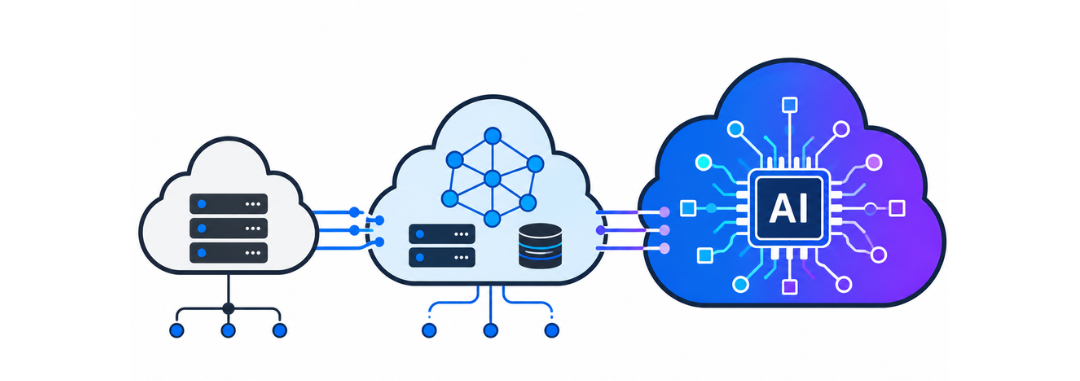
Conclusion — The Cloud 3.0 Inflection Point

🧠 What Cloud 3.0 Is

Cloud 3.0 is not a marketing term for incremental cloud improvements. It is a genuine architectural inflection — driven by the irresistible force of AI workload growth, the geopolitical reality of data sovereignty, the physical constraints of data centre energy consumption, and the latency demands of a world where 75% of enterprise data is generated outside the data centre. Each of its four pillars addresses a real, urgent problem that Cloud 2.0 architecture cannot solve.

💡 Why It Matters Now

The window for getting Cloud 3.0 architecture right is open but not indefinitely. Infrastructure decisions made in 2026 — platform choices, identity architecture, edge deployment models, GPU procurement strategies — will be expensive to reverse. Enterprises that begin the transition now, even incrementally, will have compounding advantages: operational experience, data flywheel effects from AI systems in production, and infrastructure that can serve the intelligence-driven workloads of the next five years.

🔮 The 2030 Horizon

By 2030, the distinction between "AI workload" and "cloud workload" will be meaningless — every cloud workload will have an AI component. Infrastructure will be largely self-managed through AIOps. Confidential computing will be the default, not the exception. Carbon-aware scheduling will be mandatory in regulated industries. The micro-cloud fabric connecting central data centres to the network edge will be as fundamental to enterprise architecture as the internet connection itself.

🛠️ Practical Next Steps for Enterprise Teams

Start with a Cloud 3.0 gap analysis against the four pillars. Prioritise zero-trust identity — it is the prerequisite for everything else. Make one concrete AI-native infrastructure investment in the next 12 months, whether that is a GPU-enabled cloud region, a deployed model-serving platform, or a pilot edge micro-cloud. Measure energy intensity and carbon footprint now, before it becomes a regulatory requirement. And build the internal platform engineering capability that will make Cloud 3.0 accessible to your application development teams.

🔑 Hardware Decoded Bottom Line Cloud 3.0 is the infrastructure layer that makes the AI era possible at scale. It is not a product you buy — it is an architectural philosophy you adopt. The enterprises that understand its four pillars, begin their roadmap now, and make deliberate platform choices in 2026 will be the ones who find AI genuinely transformative rather than perpetually expensive and disappointing. The infrastructure comes first. Everything else follows.

You Might Also Like

What Is an AI PC? NPU, Copilot+ and What It Means for You

How AI hardware works at the device level — the consumer side of the AI infrastructure story.

Best GPU for Gaming 2026 — RTX 5000 vs RX 9000

The GPUs powering both gaming and edge AI inference in 2026.

Best Laptops 2026 — Tested & Ranked for Every Budget

The best AI-capable laptops for professionals and enterprises in 2026.