
RAM Prices Are Rising in 2026 — Should You Buy Now?
RAM prices are increasing globally. Learn what's causing the surge, how long it might last, and whether now is the right time to upgrade.
If you've browsed for RAM recently, you've probably noticed something alarming: prices are significantly higher than they were just months ago. A 32GB DDR4 kit that cost $60–$90 in late 2024 now goes for $150–$180 or more. DDR5 has gotten even pricier. This isn't random — there's a real story behind what's happening, and it affects every PC builder, gamer, and laptop buyer. Here's everything you need to know.
What's Actually Happening to RAM Prices?
Prices Have Spiked — Fast
The RAM market in 2026 looks almost unrecognisable compared to a year ago. Contract prices for DRAM — the raw memory chips — have risen well over 100% in a single year, with some segments seeing increases of 150% or more. For consumers, this means RAM kits on retail shelves are far more expensive than they were just a few months back.
DDR5 has been hit the hardest, but DDR4 hasn't been spared either. Typically, as a newer memory generation ramps up, the older one becomes abundant and cheap. That hasn't happened this time. Both DDR4 and DDR5 are surging in price simultaneously — an unusual and painful situation for anyone trying to build or upgrade a PC.
Quick stat: Some spot market prices for DRAM chips have risen 300–1,000% from early 2025 levels. That's not a typo.
It Even Has a Name: "RAMageddon"
The tech press has started calling this crisis "RAMageddon" — and the name fits. Major memory module brands like ADATA, Corsair, and G.Skill temporarily halted new orders in late 2025 because they couldn't obtain enough chips. Some retailers even suspended RAM sales entirely to prevent stock from running out. Micron, one of the three major DRAM manufacturers, announced it would stop selling consumer-facing RAM under its Crucial brand entirely, redirecting all supply toward AI data centers.
The pricing is so volatile that some Chinese manufacturers report quotes are only valid for a single day before going up again. This is not a normal market — it's a supply crisis.
Quick tip: If you see a good price today, it may genuinely be gone tomorrow.
Why Are RAM Prices Surging? The Real Causes
1. AI Is Eating the Memory Supply
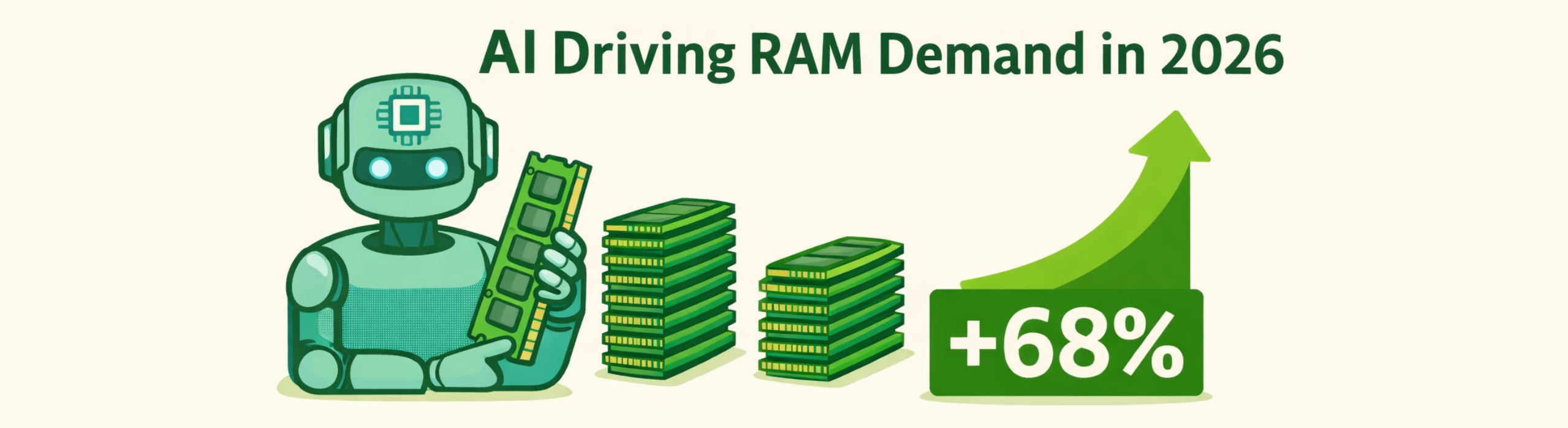
The single biggest driver of the RAM crisis is the explosion in demand from artificial intelligence. Companies building AI systems — including Nvidia, Google, AMD, and major cloud providers like AWS and Microsoft — require enormous amounts of a specialised type of memory called High Bandwidth Memory (HBM). HBM is far more demanding to manufacture than regular consumer RAM.
Here's the critical detail: when Micron makes one bit of HBM memory, it has to forgo making three bits of conventional memory. The same factories that produce your desktop RAM are being repurposed to supply AI chips. And the AI companies get first priority — they book supply years in advance and are far less sensitive to price. Regular consumers and PC builders are left competing for the scraps.
Quick tip: AI demand isn't slowing down — this is a structural shift in how memory is being used, not a temporary blip.
2. Only Three Companies Control Almost All RAM Production
Samsung, SK Hynix, and Micron collectively account for roughly 95% of the global DRAM market. This tight oligopoly gives manufacturers enormous power over supply and pricing. Reports indicate that Samsung demanded 100% higher contract prices from its customers (large OEMs like Dell and HP) in late 2025. SK Hynix publicly stated it had secured demand for its entire 2026 production capacity — meaning there is, effectively, no spare supply available for consumers.
Memory manufacturers are also deliberately prioritising high-margin products like server DDR5 and HBM over consumer-grade RAM. Standard desktop memory has become a low-priority afterthought for the companies that make it.
Quick tip: Samsung, SK Hynix, and Micron are all reporting record profits during this crisis — they have little incentive to rush a fix.
3. The DDR5 Transition Is Squeezing Supply Further
Modern platforms from Intel (12th gen and newer) and AMD (Ryzen 7000 / AM5 and newer) increasingly require DDR5. This has driven a wave of demand precisely in the market segment that's already the most constrained. Manufacturers are shifting production capacity toward the newer, higher-margin DDR5 — which reduces available supply of DDR4 while DDR5 supply itself remains tight due to AI demand.
The result is a squeeze on both generations at once. DDR4 is being phased out of manufacturing while DDR5 is being siphoned off for data centres, leaving consumers stuck in the middle.
Quick tip: Building on an older AM4 platform? Don't assume DDR4 will be cheap — it's now sometimes as expensive as DDR5 was a year ago.
4. The Broader PC Market Is Also Recovering
After a weak period in 2022–2023, the global PC and server market is picking back up. Data centres that bought servers in the 2017–2018 boom are now replacing or expanding those systems. New CPU platforms from Intel and AMD are driving an industry-wide shift to DDR5. Even smartphone sales have been stronger than expected, consuming mobile DRAM supply. All of this "normal" demand is surging at exactly the worst time — on top of the AI crisis.
Quick stat: Supply growth for DRAM in 2026 is expected to reach only 16% year-on-year — well below what's needed to meet demand.
a
How Does This Affect You?
PC Builders and Upgraders
Impact: High
If you're building a new PC or upgrading your RAM, you're already feeling this. DDR5 32GB kits that were reasonable value a year ago have more than doubled in price. Some 32GB DDR5 kits are now priced above $350. Even DDR4 kits — which should be getting cheaper as the technology ages — are selling for two to three times what they cost in mid-2024.
Pre-built PCs and laptops are also getting more expensive as OEM manufacturers pass rising component costs on to buyers. Laptop prices are expected to jump by as much as 40% in some segments.
Recommendation: If you genuinely need RAM now, buy it — waiting may mean paying even more. But don't upgrade just for the sake of it.
Gamers
Impact: Moderate
Most gamers already have sufficient RAM for current titles. If you have 16GB or more, there's no immediate need to upgrade. The price spike hurts most when you're building a new system or replacing failed hardware. For now, sit tight if your current setup works fine.
One upside: the GPU market has remained relatively unaffected by this particular crisis, so graphics cards are still available at more predictable prices.
Recommendation: Avoid upgrading RAM purely for performance gains right now — the cost-to-benefit ratio is terrible. Wait it out if your system is stable.
Laptop and Smartphone Buyers
Impact: High (incoming)
For Android brands in the mid-to-low segment, rising memory costs are forcing them to either raise prices or downgrade specifications. Some low-end smartphones in 2026 may ship with only 4GB of RAM — a step backwards after years of progress. High-end ultrathin laptops, which have memory soldered directly onto the motherboard, face early and sharp price pressure because they can't easily substitute components.
Even Apple isn't fully immune: analysts expect iPhone and MacBook pricing to come under increasing pressure as long-term supply agreements with Samsung and SK Hynix expire and new ones are renegotiated at crisis-level prices.
Recommendation: If you're buying a new laptop soon, act now while current-stock devices still carry pre-surge pricing. New models launching later in 2026 will likely be pricier.

How Long Will RAM Prices Stay High?
No Relief Until at Least 2027
This is the uncomfortable truth: most industry analysts and supply chain experts do not expect meaningful price relief before 2027 at the earliest, and full normalisation may not arrive until 2028–2029.
The reason is simple: building a new memory fabrication plant (fab) takes at least three years from the decision to break ground. Even if Samsung, SK Hynix, and Micron all started new fabs today, they would not come online until late 2028, and wouldn't be fully ramped until 2029. Until then, supply growth will remain constrained and AI demand will continue to dominate what's available.
TrendForce, one of the most respected memory market research firms, has described the scale of price increases as "unprecedented" and expects prices to remain elevated well into the second half of 2026 at a minimum.
Quick tip: Don't hold your breath for a sudden crash in prices. This is a multi-year situation, not a temporary spike.
Could Prices Drop Suddenly?
There is one scenario where prices could fall sharply: if AI investment slows dramatically or a major AI bubble bursts. In that case, demand from data centres would dry up quickly, flooding the market with unused supply and sending prices crashing downward. This is possible, but impossible to predict with confidence.
For now, the AI boom shows no signs of slowing. Major cloud providers and AI companies continue to secure memory supply aggressively, and analysts expect robust AI-driven demand to persist through at least 2026.
Quick tip: Monitor the AI investment landscape — if you see signs of a slowdown, that could be your signal to wait for a price correction.
Bottom line: The RAM price crisis of 2026 is real, significant, and unlikely to resolve quickly. The root cause — AI data centres consuming the majority of available DRAM supply — is a structural shift that will take years to correct. If you need RAM urgently, buy it now rather than gambling on a price drop. If you can wait, you probably should. Either way, make sure you understand what's driving the market before you spend.
Not sure what RAM you actually need? Start with the basics.
👉 Read our DDR4 vs DDR5 Beginner's Guide